

dystopic dystopic

bussard ramjets, cryonic stasis, and exoplanetary colonization

bussard ramjets, cryonic stasis, and exoplanetary colonization

what will it take?

hello everyone,

i'm a bit of a writer, and i can't help but feel drawn to science fiction. that shouldn't be surprising.

lately i've been reading up a great deal on theoretical physics, exobiological speculation, and all that. i was dismayed at first to learn that the chances of faster-than-light travel being physically possible are slim. it was also pretty discouraging when i sat down and looked at the actual speeds that'd be required to traverse sizable parts of the galaxy in a single conscious lifetime. it was a kick when i was down to learn about how difficult terraforming probably would be. but the more i've been learning, the more i've been excited about telling a different kind of science fiction story.

to draw an analogue to our world, the thing that made both the european colonial age and the modern process of globalization have been technology. it's not that we couldn't go to various places around the world before, it just cost too damn much to make anything worth it. i got my BA in sociology, and these sorts of things interest me.

if FTL travel isn't possible, then more than likely it'll be too damn costly to ever colonize beyond our own solar system as the way it's been envisioned in most of the celebrated scifi universes. But there are examples such as Arthur C. Clarke's Songs of a Distant Earth or Sid Meier's Alpha Centauri where humans colonize to escape destruction on earth.

recently i had the chance to meet both Kim Stanley Robinson and Geoff Ryman. Robinson is a hard scifi writer after my own heart; the Mars Trilogy is a really interesting look at our first attempts to colonize within our own star system. Ryman was actually more interesting to talk to, though. maybe because few people have ever heard of him (i was only there because i work at UCSD where he was being hosted). but i actually got to talk to him. he said he thinks we probably won't ever leave our galactic neighborhood.

i'm interested in writing a hard scifi story (or series) myself. i'm interested from a sociological point of view: what would drive us to colonize space? from a writer's point of view, i want to keep the earth around, so i'm not interested in a flight from disaster. what would societies be like after colonies were established? trade would be difficult, but not impossible. same goes for war.

while i'm certainly interested in contributions along those lines, i'm also interested in learning more about the hard science and engineering behind interstellar travel. i've got a lot of questions i haven't been able to answer through wikipedia and google alone. but i'm not about to list them all here.

it seems like a discussion about real ("real") colonization and space travel could use a place on these boards.

i'll kick it off. i've been reading up on propultion especially, and bussard ramjets seem like the most economically feasible option since they gather their fuel as they go - perhaps especially if it could be hybridized with another form such as antimatter-catalyzed fusion. the wikipedia article on bussard ramjets describe that they'd probably need what is essentially a magnetic funnel or ramscoop to gather interstellar hydrogen as propellant.

The mass of the ion ram scoop must be minimized on an interstellar ramjet. The size of the scoop is large enough that the scoop cannot be solid. This is best accomplished by using an electromagnetic field, or alternatively using an electrostatic field to build the ion ram scoop. Such an ion scoop will use electromagnetic funnels, or electrostatic fields to collect ionized hydrogen gas from space for use as propellant by ramjet propulsion systems (since much of the hydrogen is not ionized, some versions of a scoop propose ionizing the hydrogen, perhaps with a laser, ahead of the ship.) An electric field can electrostatically attract the positive ions, and thus draw them inside a ramjet engine. The electromagnetic funnel would bend the ions into helical spirals around the magnetic field lines to scoop up the ions via the starship's motion through space. Ionized particles moving in spirals produce an energy loss, and hence drag; the scoop must be designed to both minimize the circular motion of the particles and simultaneously maximize the collection. Likewise, if the hydrogen is heated during collection, thermal radiation will represent an energy loss, and hence also drag; so an effective scoop must collect and compress the hydrogen without significant heating.


talk about kick-butt imagery! spirals of heated gas careening towards a ship only to be fused and expelled in a jet plume? sweet.

anyway, i've written enough, and i hope it hasn't put anyone off. some of the the community here has proven to be very well read with regard to these kinds of science, so i thought it'd make a great topic for discussion: all things related to space exploration and colonization with reasonable extrapolations of current technology.

my biggest point of curiostiy was with respect to ramjets, so i'll take the kickoff: could the spiral motion of the inbound gas somehow be harnessed to artficially generate gravity by rotating the ship, instead of producing drag?

any volunteers?

final words: i hope no one minds my double-motive. i won't try to steer any dicussion, though if things quiet down i might pose more general questions to keep it going; i encourage anyone interested to pose your own!
436,422 views 930 replies
Reply #351 Top
lol considering that i'm gay, it'd take a lot of alcohol


hahahaha well often an ugly chick just looks a bit too manly, so your in with a good chance if your gay??! lol
Reply #352 Top
Hello All.
Firstly let me get the gushing out of the way.
Great topic Dystopic , threads like this are what make the internet great. And chaired with aplomb. Bravo.

Now to business, have you ever played any Games Workshop games? Their background for the 40K series is a widespread human dispora that sounds bit like what your aiming at. They also have what you'd probably call sudden fiction "flavour" texts spread through the rule books. Although they do have warp space and daemons and the cultures are rather homogenous as strict adherence to societal norms is enforced.
A couple of the races they use/d are Squats and Ogrins, both variants of humans. Squats are basically dwarves, shorter stockier humans caused by generations of living in tunnel networks on high G worlds. I forget what caused Ogrins to be big and stupid but it was something similar, generations of living under harsh conditons or the like.

What other enviromental conditions could affect a popluation? What if the sun was different colour? Iirc the light from the sun is a bit green, which lead through various steps (apparently) to plant life being green. Early photosythetic life utilised and absorbed the green high energy light from the sun (making them look purple). The oxygenic photosythesisers which evolved later (and lower in the sea) had only purple light left to use causing them to look green.
That was a bit of a tangent but what I was getting at was how different would society be if everything was different colour? How much meaning or significance could "Englands green and pleasant land" have if you've only ever known orange trees? What if Red, White and Blue became Red, Pink and Black due to higher intensity red light and not much blue? Possibly not much in the short term but after just a few generations how much affinity would you have with people who quite literally dont see things the same way you do?

Other variations could be built in by the method of colonization. It would probably take many more generations to significantly diversify for one of your "mothership" planted colonies with basically everything shipped down from home than it would for I think it was Denyasis' "Drop them on the planet with the people and raw materials" approach. The "Motherships" -I'm using that term as its easy, if you have one you'd prefer let me know- themselves may well have a fairly different outlook than Earth implanting diversity from the start.

I'm going to stop my gibbering for a spell now and wait to see any of that made a jot of sense. My apologies for bad grammar and spelling feel free to correct any errors.

Dystopic, I'm impressed by the breadth of your vision for these works please let me know when the books out, I'd definatly like a read.

Ben.
Reply #353 Top
hahahaha well often an ugly chick just looks a bit too manly, so your in with a good chance if your gay??! lol


yeah... telling the difference can be even more difficult in the gay scene, sorta makes one realize how much gender is constructed and social. thankfully these days i'm usually only drunk in public during football games!

Firstly let me get the gushing out of the way.
Great topic Dystopic , threads like this are what make the internet great.


well, thank you! i think the regular participants would agree (i know a couple have said regularly how much they enjoy this forum thread).

And chaired with aplomb. Bravo.


bravo to you too! i had to look up 'aplomb' -- nice word! i work in an academic setting, and a number of the course topics touch on very sensitive issues (abortion and eugenics, environmental change and global warming, the unintended consequences of Western/post-industrialized lifestyles, etc.). one thing i've learned is that it's important to maintain respect for others: no one learns anything when everyone just yells at one another.

Iirc the light from the sun is a bit green, which lead through various steps (apparently) to plant life being green. Early photosythetic life utilised and absorbed the green high energy light from the sun (making them look purple). The oxygenic photosythesisers which evolved later (and lower in the sea) had only purple light left to use causing them to look green.


i haven't found anything to support that directly    i remember reading that our sun's light is white with a slight yellowish hue. and i just found this article on wikipedia that's nicely informative. the major variant seems to be the type of pigment the photosynthetic life form uses. the major ones seem to be chlorophylls (which absorb red and blue best), carotenoids which absorb blue), and phycobilins (which absorb red through green). check out this awesome picture i found:
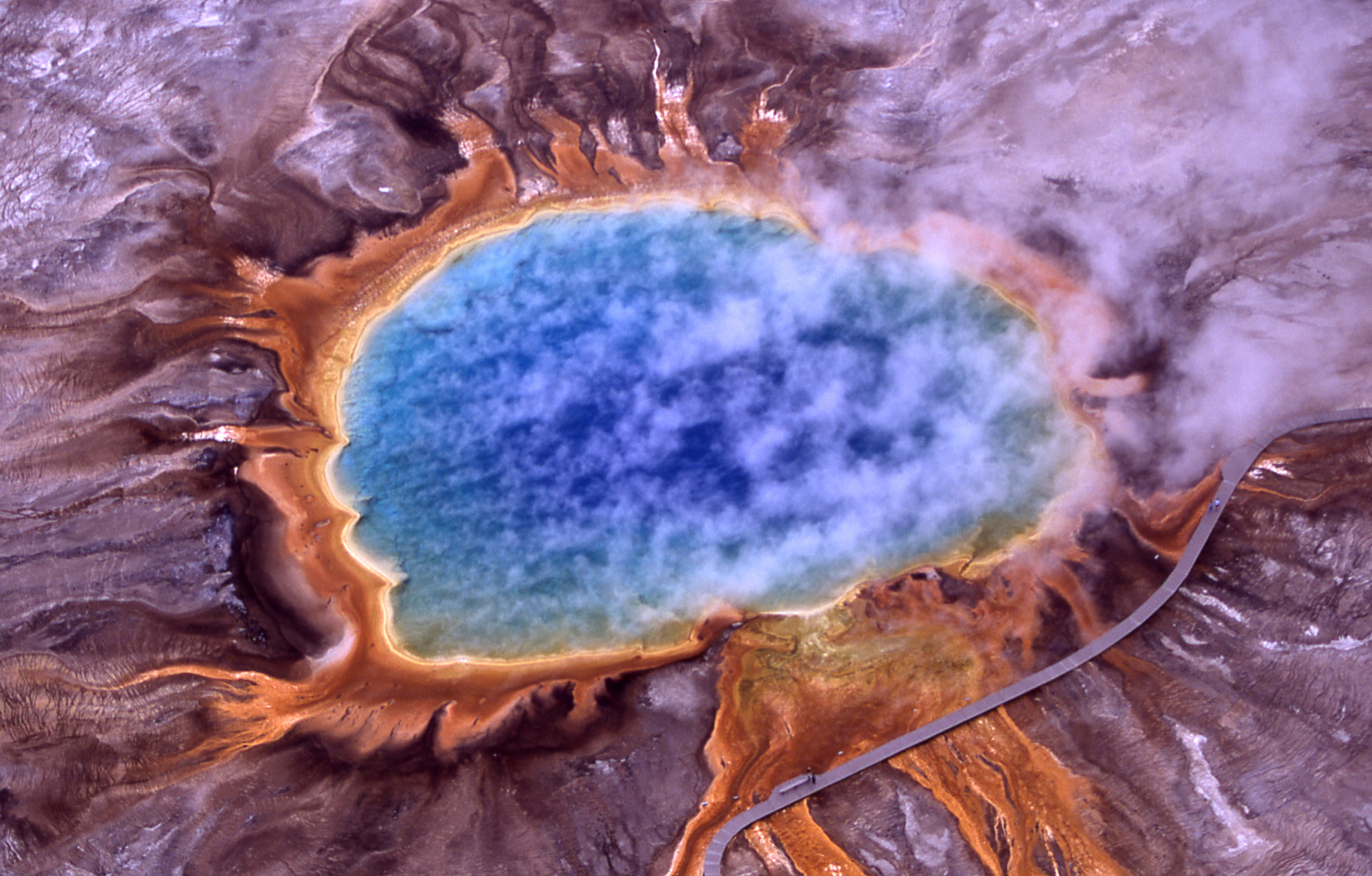

(caption from wikipedia: "The orange ring surrounding Grand Prismatic Spring is due to carotenoid molecules, produced by huge mats of algae and bacteria.")

who needs alien worlds when you can just look around on Earth and be amazed?

the color of a photosynthetic life form has to do with what spectra it doesn't absorb. purple (magenta) light is a mix or red & blue light, and it seems most photosynthetic life can absorb at least one of those two colors. though they did mention that green-efficient phycobilins can be found in deeper sea life where green light is more abundant, so perhaps it could be found there.

That was a bit of a tangent but what I was getting at was how different would society be if everything was different colour? How much meaning or significance could "Englands green and pleasant land" have if you've only ever known orange trees? What if Red, White and Blue became Red, Pink and Black due to higher intensity red light and not much blue? Possibly not much in the short term but after just a few generations how much affinity would you have with people who quite literally dont see things the same way you do?


i never fear tangets! and writers actually benefit from them greatly - you never know when a tangent will develop into a truly interesting story mechanic. this is something i think we touched on earlier when we were talking about genes and physiology. i pointed out that it'd be theoretically possible to develop eye pigments that'd absorb infrared, allowing people to see heat, as well as UV (as some birds have now). however, i'm not sure the mechanic you proposed would be ideal. most stars give off at least some light across the spectrum. calling a star "red" or "blue" really means it's got slightly more red or blue, and most depictions of stars with color are chormatically dramaticized.

but atmophere could play a huge role on the availble light on the surface of a planet. one thing i love about speculative fiction is exploring how small changes can lead to big consequences.

The "Motherships" -I'm using that term as its easy, if you have one you'd prefer let me know- themselves may well have a fairly different outlook than Earth implanting diversity from the start.


no qualms about the term at all, and this point definately relates to something i want to explore in this fictional universe: bioethics. i could imagine some groups of people holding on to their DNA sequence as something that makes them essentially human, while others would be more than willing to manipulate their own evolution - and under which social and enviornmental conditions one or the other would occur.

Dystopic, I'm impressed by the breadth of your vision for these works please let me know when the books out, I'd definatly like a read.


thanks again! you're very gracious. i think it'll be some time before anything novel-length will be publishable, but i'm thinking about doing some short stories in this universe as well. another thing that's occured to me is inviting this group to participate in the critiquing process. specifically i've thought about setting up a website where people can read and respond to my work in progress - after acquiescing to a digital non-disclosure agreement  

nice to meet you Ben!
Reply #354 Top
yeah... telling the difference can be even more difficult in the gay scene, sorta makes one realize how much gender is constructed and social.


Yes these days i am seeing more and more people and i really have no idea what sex they are? I remember at school in pre pubescent years i would sometimes get asked if i was a boy or a girl by other children! it was a bit of a shock to be asked that but did not hurt my fealings since a childs understanding of sexuality is far simpler.

Theres a good lesson that perhaps those nudist colonies are not so crazy after all??. Still, even in a nudist colony there are some people who could still cause confusion! scary thought!! lol
Reply #355 Top
A chemical bond is the atoms' electrons forming a stable orbit created by their magnetic interactions with the nuclei. It's all magnetics; but it's just referred to as chemical bonds, probably because it isn't all the relevant to most studies in chemistry. I think that most chemists are more worried about molecular reactions on a large scale rather than what goes on inside the atom.


Actually they are called chemical bonds for two reasons. First, when they were named, we didn't know about quantum physics or how the bonds worked. Secondly, its a conceptual tool. It's easier for begining student to picture "bonds" and "orbitals" even though they don't actually exist. These older theories work great with certian parts of chemistry cause the predictions about chemical behavior are still valid in certian cases.
You are right, many chemists can work using these thoeries. There are parts of chemistry, like physical chemistry and analytical chemistry where these theories no longer work and thus we transistion to the quantum mechanic theories to explain chemical behavior.

Also, side note, A Chemical bond is the resultant reorganization of two or more atoms orbital shells and electron configurations, to create a compound based on the electromagnetic (magnetic, electricity, and EM are all essentially the same thing)interactions between the electrons and the nuclei

are there any rigin/non compressable components in atoms in the first place?

Crap, I HATED pchem and Spec, but I'll give it a try. Technically, yes and no. (isn't quantum physics great?!?) All the components in atoms are non-compressible, they can't get any smaller. You can push atoms toward eachother, but as the nuclei (that can't be spelled right, sorry) get closer to eachother, a repulsive force creeps up (magnetic, I beleive). That's why it takes soo much energy to kick off a fusion reaction. It has to over come that repulsive force.


Well if you tried to make armour plating out of 100% solid atom then it would probably have so much mass you couldn't move it very efficiently if at all! but i do not think it would be a black hole. Stringing such material out to form string would also pose the question as to can you even pull it, but if you could get it thin enough, then perhaps?


Technically, atoms don't ever touch (except in things like fusion). When we walk on ground, we are never really touching it. The repulsive force between the atoms/compunds keeps the atoms of our foot from touching the atoms of the ground. Even ionic compounds (like salt, NaCl) don't touch. They just align themselves to be as close as they can get (lowest energy)

Ps - I studied a little P chem and a year of analytical chem, but my realm of knowledge was DNA and biochem, so I'm really rusty in this area - please someone correct me if I'm totally screwing something up, thanks!

And welcome to the thread Ben!
Reply #356 Top
denyasis


Nice post.

I was wondering about black holes actually, i think it is safe to say that atoms would be touching each other in there! Infact i could imagine non compressable atoms being compressed!! defying physics by compressinjg the non compressable would cause a dept or distortion in time?
Reply #357 Top
black holes don't destroy by compression. they destroy by stretching
Reply #358 Top
What other enviromental conditions could affect a popluation? What if the sun was different colour?


I think that in a civilization's early development that would have a large effect, however in a culture that has already been shaped by Earth wouldn't react as strongly to these minor changes, at least not as strongly as it would to other factors, like isolation from Earth.

another thing that's occured to me is inviting this group to participate in the critiquing process. specifically i've thought about setting up a website where people can read and respond to my work in progress - after acquiescing to a digital non-disclosure agreement


That would be sweet!

are there any rigin/non compressable components in atoms in the first place?


The atom itself is essentially compressible, though that's not exactly the best way to put it; anyways, the electrons around the nucleus can get closer/farther from the nucleus due to various effects (such as a photon striking an electron: the excited electron will go into a higher, more energetic orbit). In molecules, the bonds between atoms will bend, rotate, or even break (the latter constitutes a chemical reaction), so those too have a degree of compressibility. As denyasis mentioned, the individual particles: the electrons, neutrons, and protons, aren't compressible (though this only holds true as far as chemistry is concerned, going deeper we see that those particles are made of sub-particles, which are made of...whatever).

nuclei


That is correct.

I was wondering about black holes actually, i think it is safe to say that atoms would be touching each other in there!


Yeah, pretty much. Everything goes to heck once you're in a black hole. Going back to what I mentioned about compressibility, the atoms are non-compressible as far as chemistry is concerned. But black holes don't follow the laws of chemistry, they follow the laws of, well...heck.

black holes don't destroy by compression. they destroy by stretching


Well, yes, an object composed of many molecules ceases to function as that object because it is pulled apart by gravity. They are literally stretched out, getting longer and thinner, like taffy or pasta, which is why the process is called Spaghettification. Once your atoms get down into the heart of the beast, though, they are definitely compressed into oblivion.
Reply #359 Top
Once your atoms get down into the heart of the beast, though, they are definitely compressed into oblivion.


this should read if they get down into the heart of the beast, they may be compressed into oblivion.

since 1 we don't know if they would survive spaghuettification. or two what actually happens in the heart of the beast.
Reply #360 Top
since 1 we don't know if they would survive spaghuettification. or two what actually happens in the heart of the beast.


Well, no, they don't "survive" spaghettification. Initially, the intermolecular bonds fail, and the object is reduced to molecules, and then the object is torn apart at the molecular level, however, the atoms are still intact. Then, when they get closer, the atoms are torn apart into electrons, protons, and neutrons, and then those are torn apart ...you get the idea. They become a jumble of subatomic particles. But they are still matter though, falling further into the gravity well, with their mass contributing to the black hole's gravitational field. While we don't know specifically what happens to these particles (conflicting theories of quantum mechanics and general relativity still need to be resolved here), they are either A/ compacted into an incredibly small amount of volume, or B/ crushed into no volume at all: a singularity. In any case, this is significant compression, so I thought that "oblivion" was an appropriate word.

Besides, doesn't that word just sound awesomely cool? I mean, come on, "oblivion" has to be one of the coolest words out there!
Reply #361 Top
millertime335


Nice post!

When it comes to black holes i think the key factor is time. Since no atomic interaction, energy or gravity can occur without it. Distance and relativity are also governed by time.

You may think a distant star is 10 billion light years away but only because time says it is! If you changed time then that would change how far away the star was, also it would change the properties of matter, energy and gravity.

Experiments show the mass of a particle increasing at great velocity. It makes sense to me that the mass is increasing because of time/relativity, in other words what is increasing the mass is that time is speeding up and overlapping on itself multiplying the particle relative to normal time. On the other hand, from the perspective of the accelerated atom, the mass of the equipment in the science lab, the Earth, everything, would be decreasing.

So this means that the mass of a black hole would actually decrease from the perspective of an atom hurtling towards it at great speed. Somone observing that same atom hurtling towards the black hole would percieve the mass of the atom increasing but it is not actually a true fact.

All the above is basically wild speculation from somone who has absolutely no scientific training by the way!
Reply #362 Top
Besides, doesn't that word just sound awesomely cool? I mean, come on, "oblivion" has to be one of the coolest words out there!


i didn't argue with this word
Reply #363 Top
the sun is only about 40 million years old.

now can someone tell me where i live.
Reply #364 Top
Since no atomic interaction,


There isn't any atomic interaction because the particles aren't arranged into what we refer to as atoms. The particles, however, still have mass, and therefore gravity, so that is one interaction (the prominent one at that). They also still retain their charge; the protons repel other protons and attract electrons, electrons repel as well. But it is so minuscule compared to the gravitational forces, which is what holds them together.

It makes sense to me that the mass is increasing because of time/relativity, in other words what is increasing the mass is that time is speeding up and overlapping on itself multiplying the particle relative to normal time. On the other hand, from the perspective of the accelerated atom, the mass of the equipment in the science lab, the Earth, everything, would be decreasing.


Well, I'm no relativity expert, but that doesn't sound quite right. Who knows though, that may be it. One thing I do know is that from the outside, as we watch an object fall into a black hole it appears to slow down, and eventually just fades away. I can't say anything about what an object sees as it falls into the hole, though I'm not sure if it accelerates to light speed from the gravity. But I don't know, wiki it or something.

i didn't argue with this word


Well, if you're arguing against whether or not it compresses, my answer is: it does. Just how much is what we don't yet know.

now can someone tell me where i live.


I'm going to go out on a limb here and guess....Earth?
Reply #365 Top
There isn't any atomic interaction because the particles aren't arranged into what we refer to as atoms. The particles, however, still have mass, and therefore gravity, so that is one interaction (the prominent one at that). They also still retain their charge; the protons repel other protons and attract electrons, electrons repel as well. But it is so minuscule compared to the gravitational forces, which is what holds them together.


Sorry i miscomunicated my first line, i meant to say that atomic interaction, energy and gravity and distance cannot occur without time. Time being the enabling factor for all things.

I'm going to go out on a limb here and guess....Earth?


I think Danilost is sometimes harder to understand than the physics of a black hole! (well the universe can only communicate what it is, but humans can communicate weirdness, falseness, truth, anything at all!)
Reply #366 Top
Well, if you're arguing against whether or not it compresses, my answer is: it does. Just how much is what we don't yet know.


no not arguing against that either.

arguing against using words with an absolute meaning. when we don't know.
of course the only way to know for sure is to go in and find out. any volunteers.
Reply #367 Top
I'm going to go out on a limb here and guess....Earth?


no Pluto
Reply #368 Top
despite the distance a planet is from the sun it only takes one year to go around the sun.

but since we always use earth comparisons. so that people understand how long each of those years are to us. we have forgotten that.
Reply #369 Top
arguing against using words with an absolute meaning. when we don't know.
of course the only way to know for sure is to go in and find out. any volunteers.


Using an absolute word to describe somthing in a theoretical non asuming way is fine.


Reply #370 Top
I think Danielost is sometimes harder to understand than the physics of a black hole! (well the universe can only communicate what it is, but humans can communicate weirdness, falseness, truth, anything at all!)


sorry i think differently than most people do.


for instance i am still wondering why we are waiting for Boeing 747. when we have a perfectly good sailing vessel to go and colonize mars.
Reply #371 Top
sorry i think differently than most people do.


So do i! I'm the guy who grew up thinking teachers at school only knew 1 word - blah! blah blah blah blabla blah. Then i would look around and see all the other kids writing stuff and wonder how the hell they all know what to do?? So i would just work stuff out myself, thats what got me through school.
Reply #372 Top
sheesh! i'm gonna have a lot of catching up to do... i can't do it now. i had to facilitate TA training today, and i don't have internet access at home again until Friday (roommate forgot to pay the bill). so don't hold the train on my account; but neither i haven't abandoned the forum by any means.
Reply #373 Top
(roommate forgot to pay the bill)


lol, my bill gets paid automatically from my credit card. Although i am planning to get rid of my credit card soon (to stop the dept creep) so i will be in trouble then!

Here in Australia you cannot do automatic payments because the banks charge around AUD $30.00 or US $26.00 disshonour fees. So i will be back to the old forgetting to pay bills treadmill again!
Reply #374 Top
One thing I do know is that from the outside, as we watch an object fall into a black hole it appears to slow down


Really? Not trying to argue but I'm not really understanding this. I mean, if the gravity of the black hole is interacting with Object A, then a continual force is applied on Object A, hence constant (more or less) acceleration. That would mean the object's speed would increase as it moved into the black hole. If its slowing down, there must be a repulsive force (assumingly from the black hole) pushing Object A away, which seems to go against everything I've ever heard/known about black holes.

Am I understanding this correctly?


And speaking of atoms and fusion. What if we used Fussion as a direct propulsion? Today we strap on high explosives to make rockets, what if we "Funneled" (for lack of a better word) several fusion (or just plain old nuclear) reactions to move a ship - an H-bomb rocket! Then carefully plan out a few sling shot maneuvers to get some additional speed before taking off out of the solar system? I don't know if there is anything out there that can handle a fusion explosion, but hey, it sounds cool!
Reply #375 Top
(or just plain old nuclear) reactions to move a ship


we already have this design. it is no faster than the chemical. it is stronger.

i got this info from a nasa scientist that was in my cab

he said the chemical was a car and the nuke was a truck.